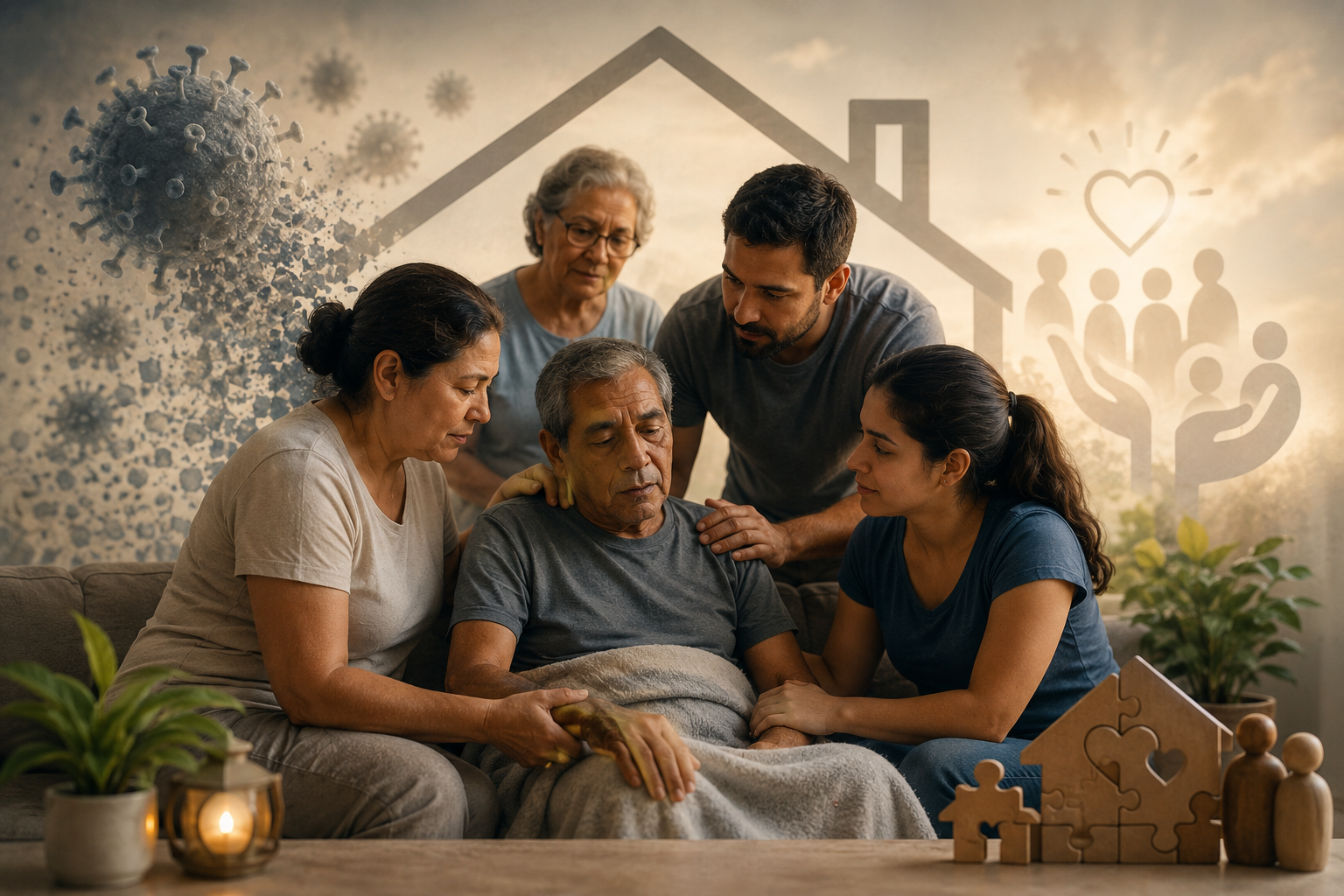
Family care for individuals with post-COVID-19 condition at home
DOI:
https://doi.org/10.18554/refacs.v14i00.8875Keywords:
COVID-19, Family, Nursing, Home EnvironmentAbstract
Objective: to understand the dynamics of family care provided to individuals with post-COVID-19 condition at home. Methods: this qualitative study was based on Ingrid Elsen’s attributes of family care and was conducted at a post-COVID outpatient clinic in a teaching hospital in the southern region of the state of Rio Grande do Sul, Brazil. The sample was purposive, and data collection took place between March and August 2022 through semi-structured interviews, as well as the construction of genograms and ecomaps. Data were organized using the IRAMUTEQ software and analyzed using content analysis. Results: a total of 20 participants were included, comprising 10 individuals with post-COVID-19 condition and 10 family members, representing 10 families. Two categories emerged: “When we needed it, everyone came together”: care for individuals with post-COVID-19 condition; and “When you are sick, that is when you have friends”: community participation in care. Individuals with post-COVID-19 condition reported persistent symptoms such as fatigue, motor limitations, cognitive changes, and emotional vulnerability, which compromised their autonomy and return to daily activities. Families reorganized routines, shared responsibilities, and mobilized affective, community, and spiritual support networks. This care was complex and continuous, sustained by strong bonds and practices of protection, presence, and the promotion of well-being. Conclusion: family involvement revealed not only the capacity to cope with the complications and uncertainties of post-COVID-19 condition, but also the importance of institutional recognition of the family as a key agent in care.
References
1. WORLD HEALTH ORGANIZATION (WHO). A clinical case definition of post COVID-19 condition by a Delphi consensus. [Internet]. 2021. [citado em 10 jul 2025]. Disponível em: https://www.who.int/publications/i/item/WHO-2019-nCoV-Post_COVID-19_condition-Clinical_case_definition-2021.1
2. Humphreys H, Kilby L, Kudiersky N, Copeland R. Long COVID and the role of physical activity: a qualitative study. BMJ Open. [Internet]. 2021 [citado em 10 jul 2025]; 11(3):e047632. DOI: https://doi.org/10.1136/bmjopen-2020-047632
3. Ida FS, Ferreira HP, Vasconcelos AKM, Furtado IAB, Fontenele CJPM, Pereira AC. Síndrome pós-COVID-19: sintomas persistentes, impacto funcional, qualidade de vida, retorno laboral e custos indiretos - estudo prospectivo de casos 12 meses após a infecção. Cad Saúde Pública [Internet]. 2024 [citado em 25 jul 2025]; 40(2):e00022623. Disponível em: https://www.scielo.br/j/csp/a/wwLTHJKnvz5qJTzdHZT4pDp/?lang=pt
4. Buttery S, Philip KEJ, Williams P, Fallas A, West B, Cumella A, et al. Patient symptoms and experience following COVID-19: results from a UK-wide survey. BMJ Open Respir Res [Internet]. 2021 [citado em 02 ago 2025]; 8(1):e001075. DOI: https://doi.org/10.1136/bmjresp-2021-001075
5. Samper-Pardo M, Oliván-Blázquez B, Magallón-Botaya R, Méndez-López F, Bartolomé-Moreno C, León-Herrera S. The emotional well-being of Long COVID patients in relation to their symptoms, social support and stigmatization in social and health services: a qualitative study. BMC Psychiatry [Internet]. 2023 [citado em 02 ago 2025]; 23(1):68. DOI: https://doi.org/10.1186/s12888-022-04497-8
6. Shah R, Ali FM, Nixon SJ, Ingram JR, Salek SM, Finlay AY. Measuring the impact of COVID-19 on the quality of life of the survivors, partners and family members: a cross-sectional international online survey. BMJ Open [Internet]. 2021 [citado em 05 ago 2025]; 11(5):e047680. DOI: https://doi.org/10.1136/bmjopen-2020-047680
7. Törnbom K, Engwall M, Persson HC, Palstam A. Back to life: Is it possible to be myself again? A qualitative study with persons initially hospitalised due to COVID-19. J Rehabil Med [Internet]. 2022 [citado em 03 set 2025]; 54:jrm00327. DOI: https://doi.org/10.2340/jrm.v54.2742
8. Elsen I. Cuidado familial: uma proposta inicial de sistematização conceitual. In: Elsen I, Marcon SS, Santos MR, organizadores. O viver em família e sua interface com a saúde e a doença. 2ed. Maringá: EdUEM; 2002. p. 19-28.
9. Bergmans RS, Chambers-Peeple K, Yu C, Xiao LZ, Wegryn-Jones R, Martin A, et al. “I’m still here, I’m alive and breathing”: The experience of Black Americans with long COVID. J Clin Nurs [Internet]. 2023 [citado em 03 set 2025]; 33:162-77. DOI: https://doi.org/10.1111/jocn.16733
10. Almeida PF, Casotti E, Silvério RFL. Trajetórias assistenciais de usuários com COVID-19: das medidas preventivas à reabilitação. Cad Saúde Pública [Internet]. 2023 [citado em 19 ago 2025]; 39:e00163222. Disponível em: https://cadernos.ensp.fiocruz.br/ojs/index.php/csp/article/view/8272
11. Leandro J de S, Christoffel MM. Cuidado familial de recém-nascidos no domicílio: um estudo de caso etnográfico. Texto Contexto Enferm [Internet]. 2011 [citado em 06 set 2025]; 20(spe):223-31. Disponível em: https://www.scielo.br/j/tce/a/BGt3cxbfh4vsRCpX4BSfvvr/?lang=pt
12. Silveira A, Neves ET, Paula CC. Cuidado familial das crianças com necessidades especiais de saúde: um processo (sobre)natural e de (super)proteção. Texto Contexto Enferm [Internet]. 2013 [citado em 06 set 2025]; 22(4):1106-1114. Disponível em: https://www.redalyc.org/pdf/714/71429843029_2.pdf
13. Soccol KLS, Terra MG, Girardon-Perlini NMO, Ribeiro DB, Silva CT, Camillo LA. O cuidado familial ao indivíduo dependente de álcool e outras drogas. Rev Rene [Internet]. 2013 [citado em 06 set 2025];14(3):549-57. Disponível em: https://www.redalyc.org/pdf/3240/324027991011.pdf
14. Konradsen H, Brødsgaard A, Østergaard B, García-Vivar C, Svavarsdottir EK, Dieperink KB, et al. The COVID-19 Post Pandemic: Family Nursing Now More Than Ever. J Fam Nurs [Internet]. 2023 [citado em 02 out 2025]; 29(1):3-5. DOI: https://doi.org/10.1177/10748407221147965
15. Rolland JS. COVID-19 Pandemic: Applying a Multisystemic Lens. Fam Process [Internet]. 2020 [citado em 04 out 2025]; 59(3):922-36. DOI: https://doi.org/10.1111/famp.12584
16. Cardano M. Manual de pesquisa qualitativa: A contribuição da teoria da argumentação. Petrópolis, RJ: Editora Vozes, 2017. 376p.
17. Camargo BV, Justo AM. IRAMUTEQ: um software gratuito para análise de dados textuais. Temas Psicol [Internet]. 2013 [citado em 05 ago 2025]; 21(2):513-8. DOI: https://doi.org/10.9788/TP2013.2-16.
18. Bardin L. Análise de Conteúdo. São Paulo: edições 70. 2016. 279p.
19. Bellini LC, Rodrigues TFCS, Sanches RCN, Nitschke RG, Giacon-Arruda BCC, Radovanovic CAT. Quotidiano familial diante o adoecimento por COVID-19: à luz da sociologia compreensiva de Michel Maffesoli. Texto Contexto Enferm [Internet]. 2022 [citado em 04 out 2025]; 31:e20220184. DOI: https://sciprofiles.com/publication/view/9cb9d8dc4199441a2c3d446de3a8db52
20. Meira EC, Reis LA, Gonçalves LHT, Rodrigues VP, Philipp RR. Vivências de mulheres cuidadoras de pessoas idosas dependentes: orientação de gênero para o cuidado. Esc Anna Nery [Internet]. 2017 [citado em 25 out 2025]; 21(2):e20170046. Disponível em: https://www.eanjournal.org/article/10.5935/1414-8145.20170046/pdf/ean-21-2-e20170046-trans1-trans2.pdf
21. Robinson‐Lane SG, Leggett AN, Johnson FU, Leonard N, Carmichael AG, Oxford G, et al. Caregiving in the COVID ‐19 pandemic: family adaptations following an intensive care unit hospitalisation. J Clin Nurs [Internet]. 2022 [citado em 25 out 2025]; 33:203-14. DOI: https://doi.org/10.1111/jocn.16560
22. Santos ED, Rocumback PCJ, Pucci SHM. Saúde mental e espiritualidade: contexto pandemia COVID-19. Saúde Coletiva [Internet]. 2022 [citado em 08 nov 2025]; 12(75):10105-18. DOI: https://doi.org/10.36489/saudecoletiva.2022v12i75p10105-10118
23. Scorsolini-Comin F, Rossato L, Cunha VF da, Correia-Zanini MRG, Pillon SC. A religiosidade/espiritualidade como recurso no enfrentamento da COVID-19. Rev Enferm Centro-Oeste Min [Internet]. 2020 [citado em 12 nov 2025]; 10:e3723. DOI: http://doi.org/10.19175/recom.v10i0.3723
24. Kogan LR, Currin-McCulloch J, Bussolari C, Packman W, Erdman P. The psychosocial influence of companion animals on positive and negative affect during the covid-19 pandemic. Animals [Internet]. 2021 [citado em 15 dez 2025]; 11(7):2084. DOI: https://doi.org/10.3390/ani11072084
25. Santos RQ, Ningeliski AO. Família multiespécie: uma nova forma de ser família. Acad Dir [Internet]. 2024 [citado em 05 dez 2025]; 6:933-57. DOI: https://doi.org/10.24302/acaddir.v6.4440
26. Souza MM, Castro A. Repercussão do animal de estimação na saúde mental de indivíduos na fase adulta. Panorâmica [Internet]. 2022 [citado em 05 dez 2025]; 35:394-409. Disponível em: https://periodicoscientificos.ufmt.br/revistapanoramica/index.php/revistapanoramica/article/view/1498
Downloads
Published
Issue
Section
License
Copyright (c) 2026 Revista Família, Ciclos de Vida e Saúde no Contexto Social

This work is licensed under a Creative Commons Attribution-NonCommercial 4.0 International License.
Each of the authors of the manuscript must complete and sign a copy of Statement of Responsibility and Copyright Transfer Agreement, which must be attached, by the submitting author, in step 4 of the submission process in the journal system (Click on the "Browse" option, select the file that should be inserted in pdf format, click on the "Download" button, in the "Title" field type: Declaration of responsibilities, then click the "Save and Continue" button and proceed with the submission process.
Note: Including scanned signature will not be accepted. Each author of the manuscript must complete a declaration individually.

REFACS de Universidade Federal do Triângulo Mineiro está licenciado com uma Licença Creative Commons - Atribuição-NãoComercial 4.0 Internacional.
Baseado no trabalho disponível em www.uftm.edu.br.
Podem estar disponíveis autorizações adicionais às concedidas no âmbito desta licença em http://www.uftm.edu.br/refacs.


 Revistas UFTM