
Lifeguard swimming: front-crawl and up-head front-crawl, arm-stroke efficiency, and kinematics
DOI:
https://doi.org/10.18554/aces.8377Abstract
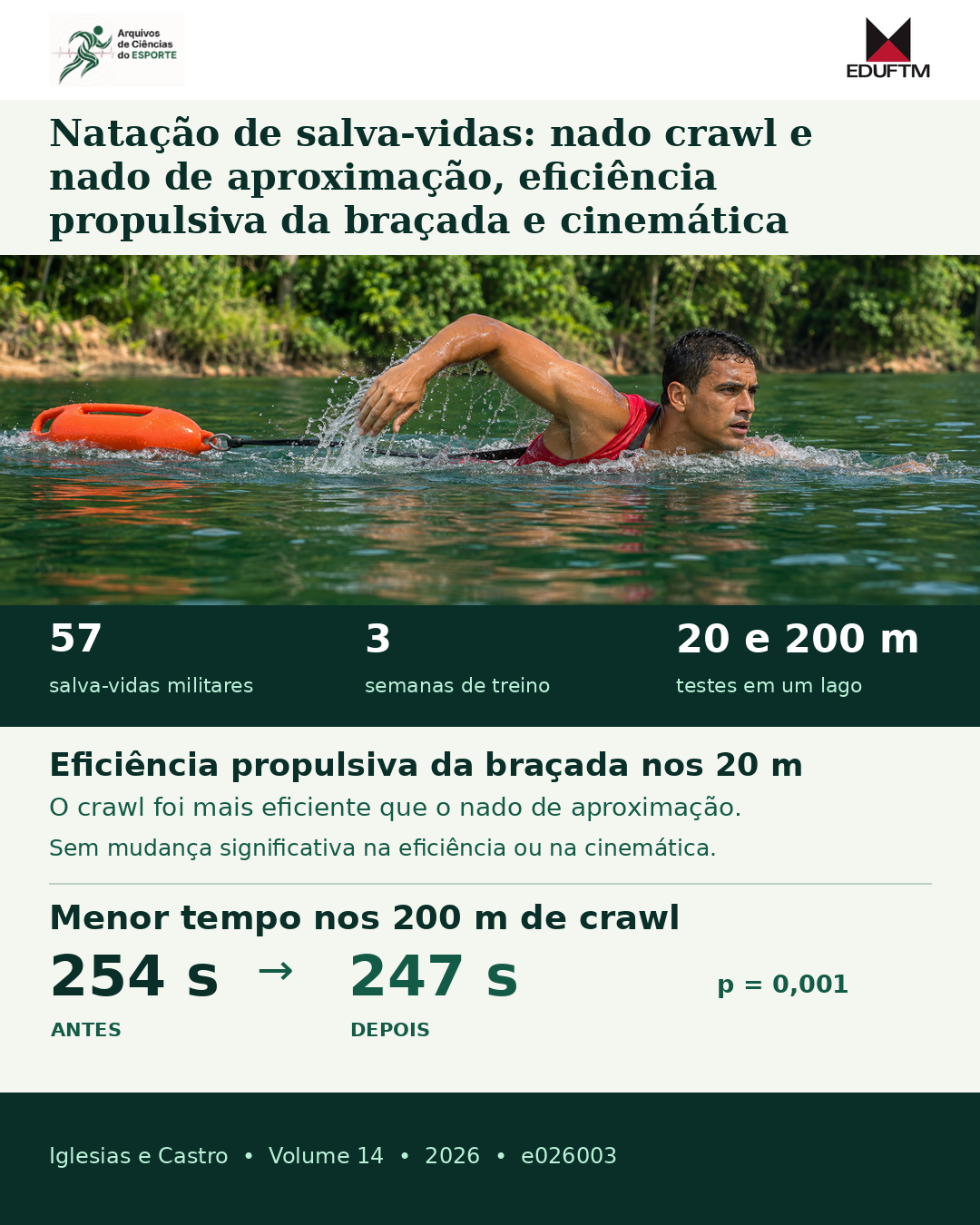
This study compared the arm-stroke efficiency, kinematics, and performance and verified the effects of three weeks of preparatory training on the front-crawl (FC) and the up-head front crawl (UH) performed by lifeguards. Fifty-seven male military lifeguards (33.5 ± 5.9 years; and 8.2 ± 5.8 years of experience) performed two sets of tests in a pond, pre- and post- three weeks of training: (i) 200 m FC all-out (T200), and (ii) two 20 m trials, one in FC and other in UH. We highlight: the arm-stroke efficiency was higher in FC (respectively pre- and post: 26.9±4.3 and 26.8±3.8%) than in UH (respectively pre- and post: 22.0±3.0 and 21.9±2.9%) and the training period did not change the arm-stroke efficiency (p>0.05). FC T200 performance has improved after the training period (254±31 vs 247±33 s; p=0.001). Three weeks of specific training of lifesaving improved the lifeguards swimming endurance capacity.
Downloads
Published
Issue
Section
License
Copyright (c) 2026 FILES OF SPORTS SCIENCE

This work is licensed under a Creative Commons Attribution-NonCommercial 4.0 International License.


 Revistas UFTM