
Benefits of Different Deep-Water Running Periodization Strategies for Muscular Strength in Older Adults
DOI:
https://doi.org/10.18554/aces.8444Abstract
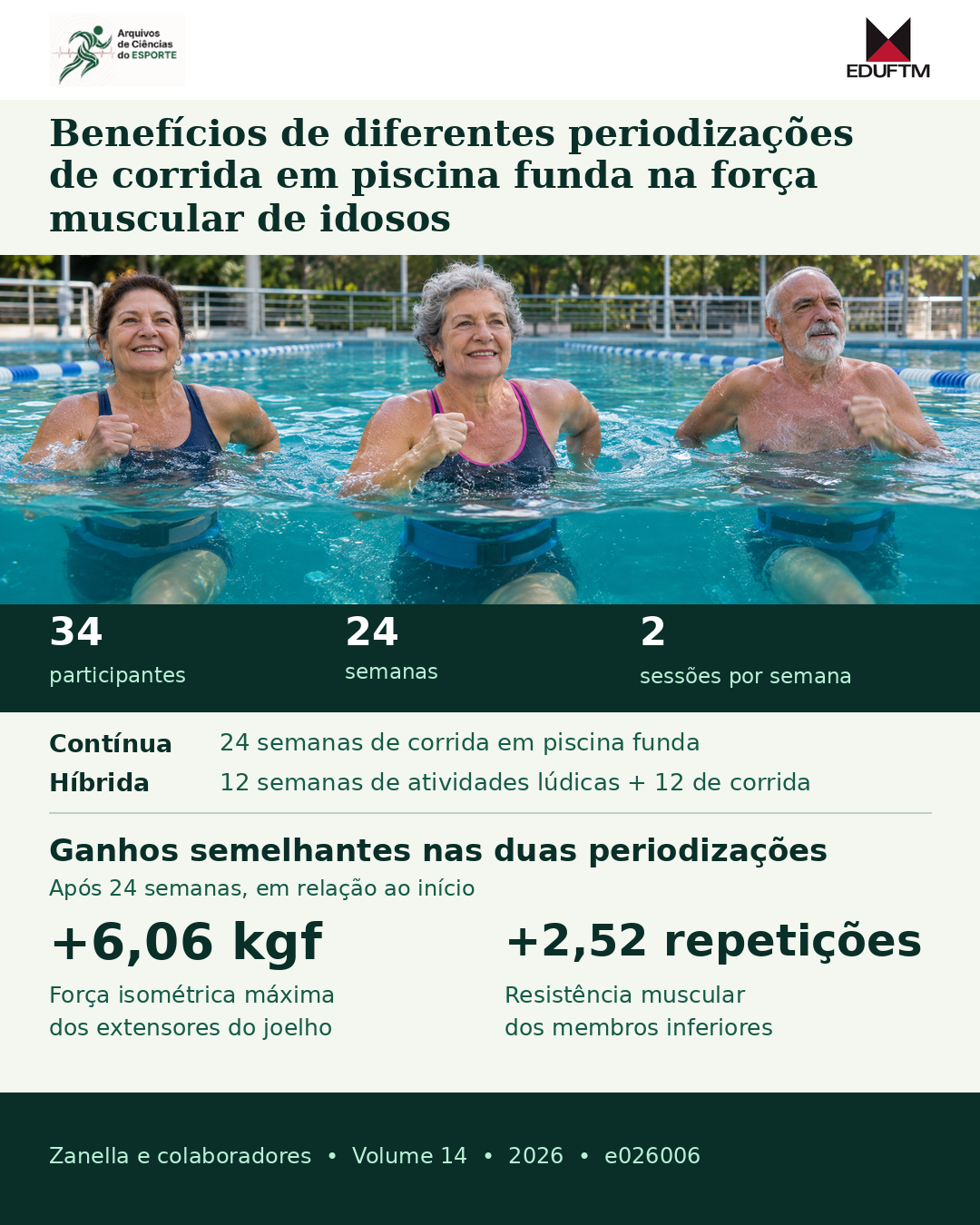
Purpose: to evaluate the effects of different Deep Water Running (DWR) training periodizations on the neuromuscular responses of elderly individuals. Methods: quasi-experimental design with two weekly sessions and duration of 24 weeks. Participants were randomized into Continuous Periodization Group (CPG, n=17) and Hybrid Periodization Group (HPG, n=17). The CPG performed a periodization with intensity progression over the 24 weeks, while the HPG performed the initial 12 weeks of recreational activities and the final 12 weeks with periodization equal to the CPG. The primary outcome was Maximum Voluntary Isometric Contraction (MVIC) of knee extensors and the secondary outcomes were Lower Limb Resistance Strength (LRFS), Rectus Femoris Electromyography (ERF) and Vastus Lateralis (EVL). Results: There was a significant increase in MVIC after 24 weeks of training, with no differences between groups (GPC: ?=7.2; GPH: ?=9.9kg). ERF and EVL remained similar to baseline levels after 24 weeks. Only GPC showed significant increases in MRMI after 24 weeks (GPC: ?=3.3; GPH: ?=2.0 reps). Conclusions: both periodizations resulted in increases in different manifestations of muscular strength, but the group with continuous periodization showed a slight advantage at the end of 24 weeks. Although no improvements were observed in electromyography, DWR may be a useful tool to improve muscular strength in elderly individuals.
Downloads
Published
Issue
Section
License
Copyright (c) 2026 FILES OF SPORTS SCIENCE

This work is licensed under a Creative Commons Attribution-NonCommercial 4.0 International License.


 Revistas UFTM