
A warm-up program improves musculoskeletal outcomes in handball athletes.
DOI:
https://doi.org/10.18554/aces.8620Abstract
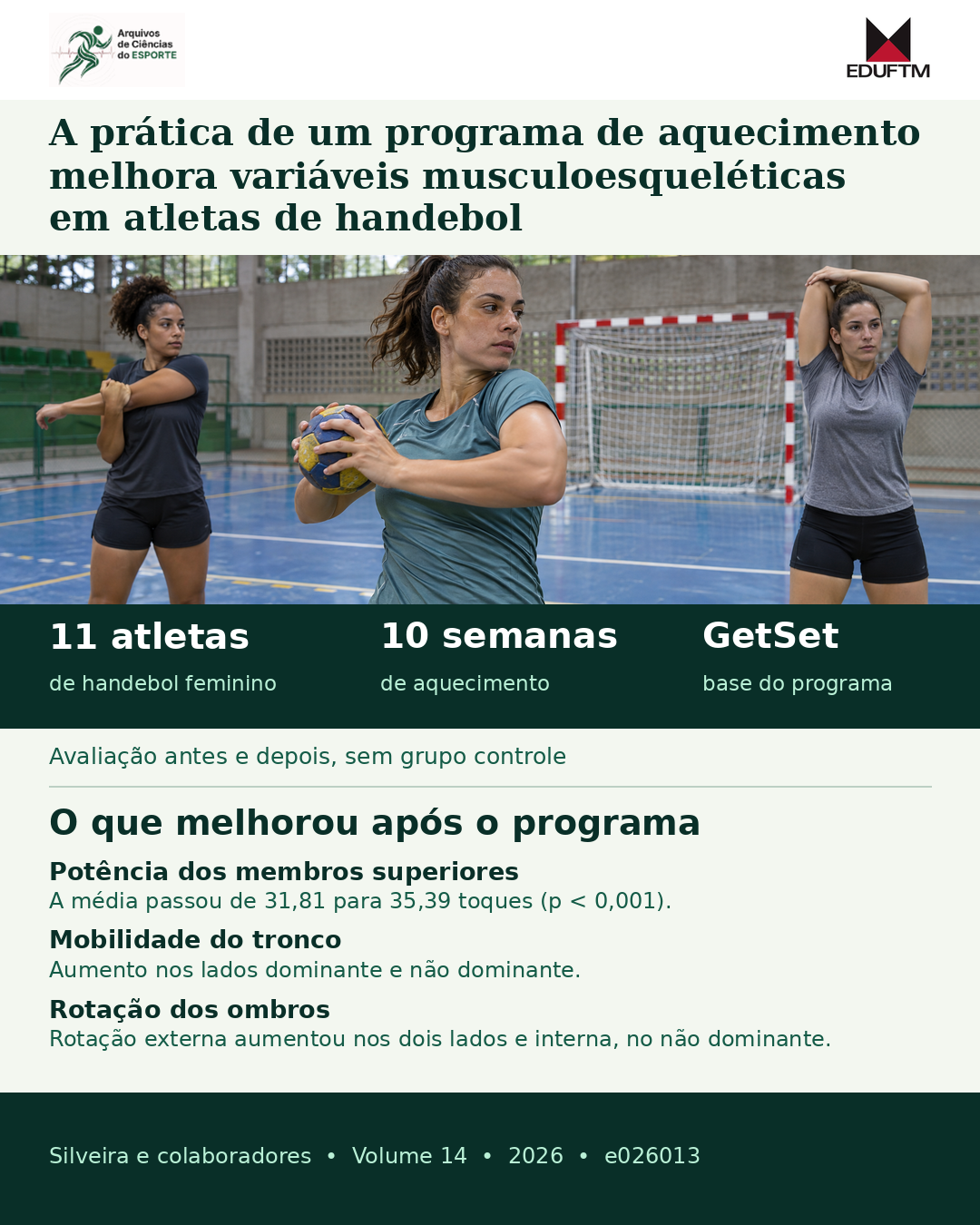
Objective: To evaluate the effects of a warm-up program on glenohumeral rotational mobility, trunk mobility, and upper-limb power in female handball players. Methods: Eleven female handball players (age, 27.82 ± 8.88 years; body mass, 74.64 ± 11.48 kg; height, 1.62 ± 0.09 m) were assessed before and after the intervention. Glenohumeral rotational mobility and trunk mobility were measured using a digital inclinometer. Upper-limb power was assessed using the Closed Kinetic Chain Upper Extremity Stability Test (CKCUEST). The 10-week warm-up program was based on the Get Set app and included exercises targeting trunk mobility, glenohumeral rotation, and upper-limb power. Results: Upper-limb power increased significantly (p < 0.001), as did trunk mobility on the dominant (p = 0.007) and nondominant (p < 0.001) sides. External rotation increased in the dominant shoulder (p = 0.002). In the nondominant shoulder, internal rotation (p = 0.001), external rotation (p < 0.001), and total rotational range of motion (p < 0.001) increased significantly. Conclusion: The warm-up program improved upper-limb power and trunk mobility, both relevant to performance and injury prevention. Internal rotation of the dominant shoulder remained unchanged. These findings support the use of dynamic, sport-specific warm-ups in handball and suggest that additional strategies may be needed to address limitations in joint mobility.
Downloads
Published
Issue
Section
License
Copyright (c) 2026 FILES OF SPORTS SCIENCE

This work is licensed under a Creative Commons Attribution-NonCommercial 4.0 International License.


 Revistas UFTM