
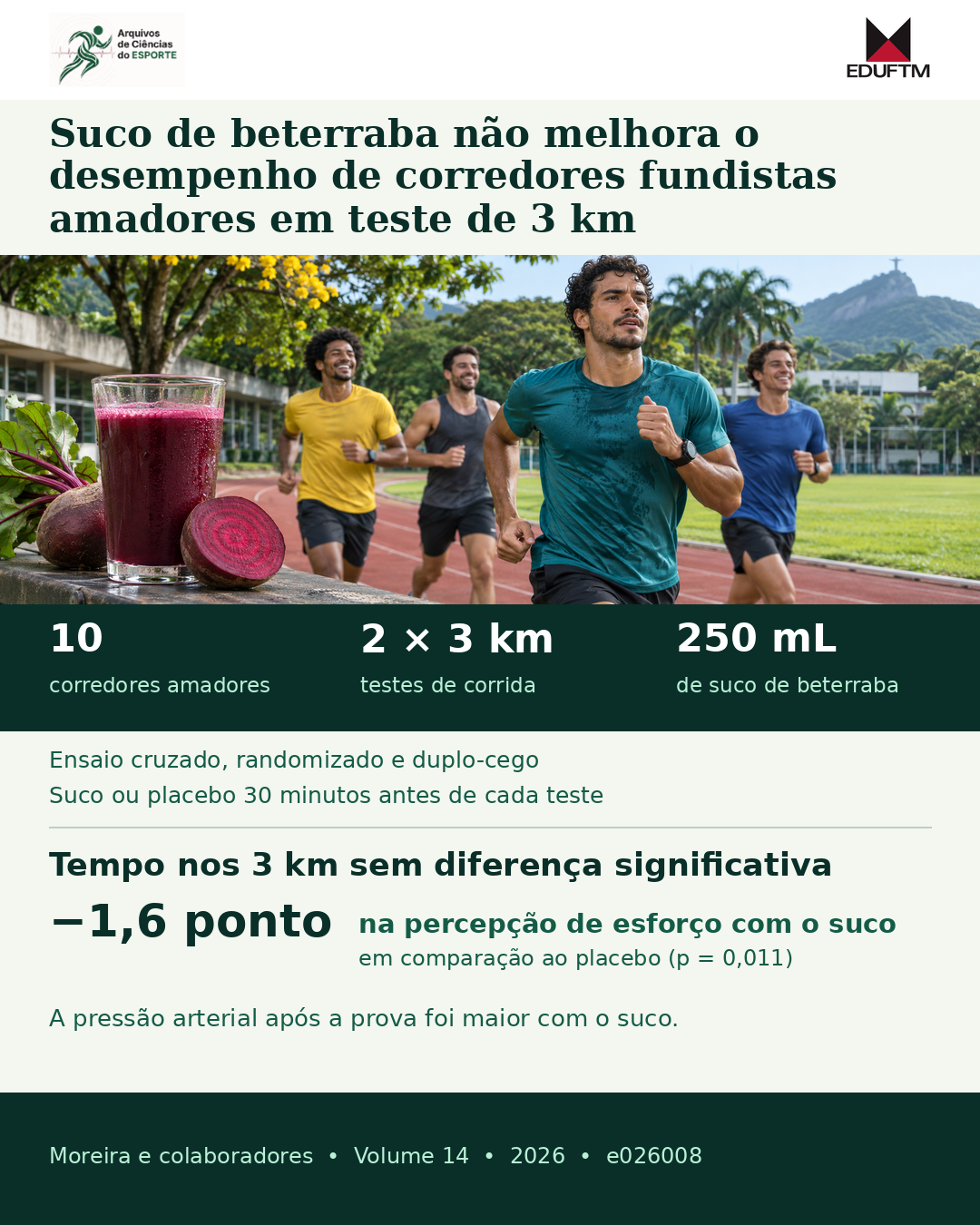
Beetroot juice does not improve the performance of amateur long-distance runners in a 3 km test
DOI:
https://doi.org/10.18554/aces.8929Abstract
Objective: To evaluate the effect of ingesting 250 ml of beetroot juice on the performance of endurance runners. Methods: A randomized, double-blind, crossover, placebo-controlled clinical trial was conducted with ten trained male recreational runners (18.20 ± 2.44 years; 69.64 ± 10.09 kg; 1.76 ± 0.09 m). Each participant performed two 3-km running tests, separated by a 48-hour interval. Beetroot juice or placebo was ingested 30 minutes before each test. Running time, maximum heart rate, capillary blood glucose, blood pressure, and rate of perceived exertion were assessed. Results: No significant differences were observed between conditions for running time, maximum heart rate, or final blood glucose. However, post-test systolic and diastolic blood pressure values were higher after beetroot juice ingestion. The rate of perceived exertion was reduced following beetroot juice consumption. Conclusion: Beetroot juice ingestion does not improve 3 km running performance but reduces perceived exertion, suggesting a possible perceptual ergogenic benefit.
Downloads
Published
Issue
Section
License
Copyright (c) 2026 FILES OF SPORTS SCIENCE

This work is licensed under a Creative Commons Attribution-NonCommercial 4.0 International License.


 Revistas UFTM