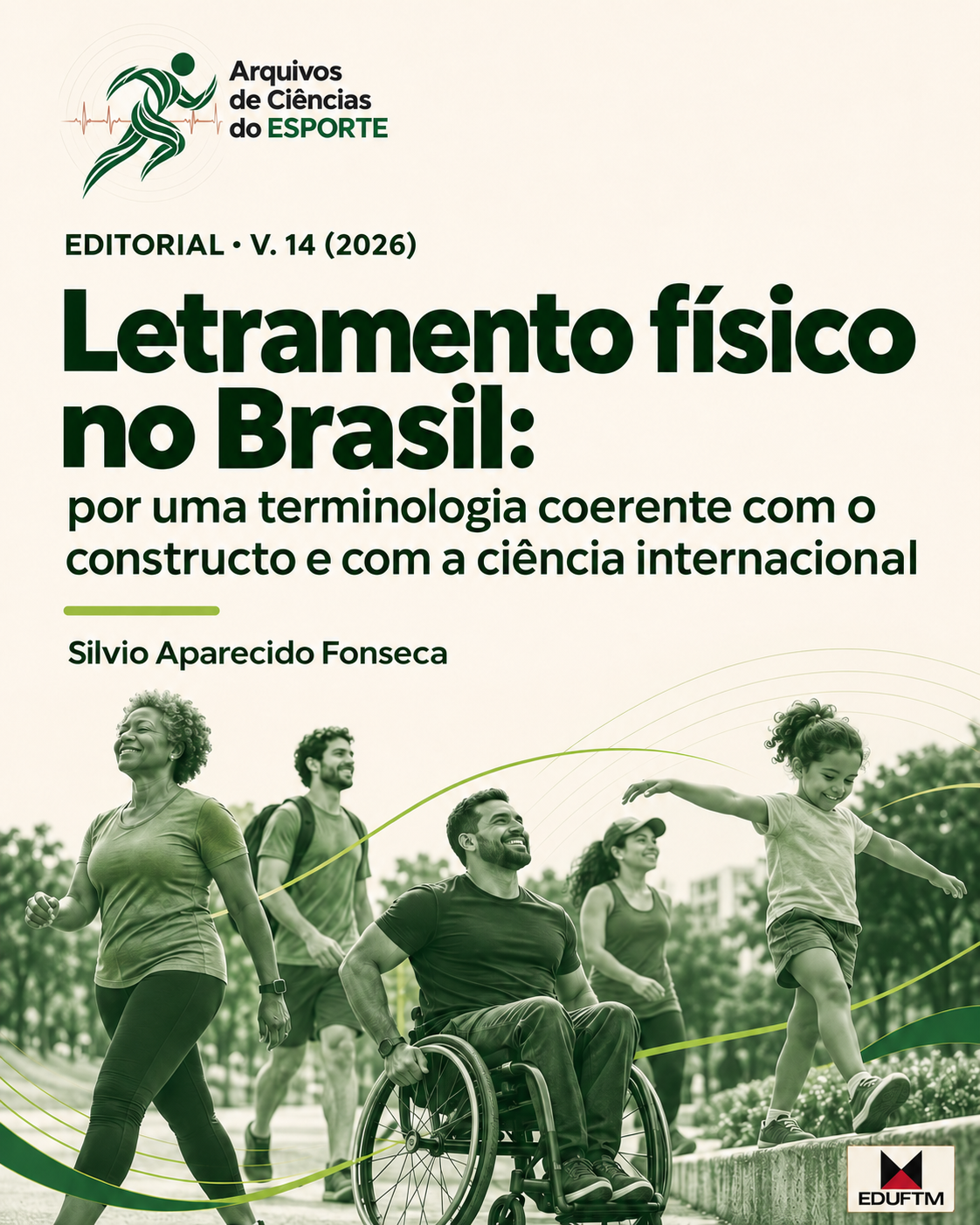
Physical literacy in Brazil: towards a terminology consistent with the construct and with international science
DOI:
https://doi.org/10.18554/aces.9435Abstract
Recently, following a Delphi research process that involved 59 researchers from every continent, *The Global Physical Literacy Action Framework* (GloPL) was published. Experts in the field, along with members of 21 societies spanning physical activity, health, education, and sports, were consulted. Consequently, physical literacy is now framed through perspectives that are culturally and linguistically sensitive to the construct. The GloPL describes physical literacy as the foundation for lifelong physical activity. It encompasses a range of integrated capacities that shape an individual’s engagement in physical activity—specifically, affective/emotional capacities (e.g., motivation or confidence), physical capacities (e.g., movement competence or physical fitness), and cognitive capacities (e.g., knowledge or understanding). The GloPL also acknowledges that, in some countries, social, spiritual, and perceptual dimensions—or those related to one’s connection with nature—are also incorporated.
This endeavor, which culminated in the *Global Physical Literacy Action Framework*, deserves to be commended. Naturally, reconciling practical, operational perspectives with the more conceptual and philosophical aspects of physical literacy within a global document is no simple task. Nevertheless, the GloPL demonstrates that such an integration is possible, even in the absence of a robust, cooperative mindset among nations. In this context, three questions arise for the Brazilian scientific community: (1) the translation of the term "literacy"; (2) the translation of the term "physical"; and (3) the need to advance initiatives in advocacy, education, assessment, research, and practice.
The first question appears to be resolved, as theoretical and linguistic justifications have made the translation of "literacy" as *letramento* widely accepted in Brazil. The second question also appears to be settled; just as the translation of "physical education" as *educação física* and "physical activity" as *atividade física* is straightforward, the same applies to the translation of the term "physical" within the concept of "physical literacy." Furthermore, the use of the term "physical" is suggested even by Margaret Whitehead—a key figure in the dissemination of the "physical literacy" construct—in her original work. The third issue, which concerns the need to advance initiatives across the interconnected areas of advocacy, education, assessment, research, and practice, is particularly compelling. Regarding research specifically, the GloPL (Global Physical Literacy) framework outlines five challenges for the national and international scientific community to address. Below is a synthesis and interpretation of this document, contextualized for our own reality.
First, debates regarding the foundations of physical literacy remain significant. However, greater effort is required to investigate the moderators, determinants, facilitators, barriers, and outcomes associated with physical literacy. By building a more robust evidence base and adopting the principles of implementation science, the challenge of translating the physical literacy construct into practice can be met with greater success.
The challenge of facilitating and monitoring national discussions on physical literacy can be effectively addressed by following the recommendations set forth in the GloPL. It is essential to build bridges between researchers, as analyzing the current state of the field and identifying conceptual overlaps can lead to more effective translation into practice. Scientific journals play a vital role in this endeavor.
As noted in the GloPL, inclusive research focused on disadvantaged populations is also a priority in our country. Globally, there appears to be a scarcity of research on physical literacy involving individuals from low socioeconomic backgrounds, Indigenous peoples, refugees, people with disabilities, and those with chronic health conditions. There are also significant research gaps across the entire life course, particularly concerning older adults. Furthermore, fostering synergistic academic collaboration among countries in the Global South represents an additional challenge for Brazilian researchers.
It is essential for researchers to act as catalysts and partners in advocacy, education, and assessment, thereby promoting high-quality experiences across various sectors. Regarding this challenge, I believe that the natural translation of the term "physical literacy" into Portuguese as *letramento físico* facilitates the academic community’s ability to navigate different registers of language for diverse audiences. Scientific communication (among researchers) becomes clearer, and for the purposes of synthesis studies, it improves both the specificity and sensitivity of search operations. In the context of science outreach (from researchers to policymakers and the general public) and the curation of scientific knowledge (from researchers to practitioners in the field), the clarity and objectivity of the term *letramento físico* streamline communication, creating the space and time needed to address other priorities.
Finally, the fifth challenge identified by GloPL—promoting international, interdisciplinary, and intersectoral research collaborations—demands an even greater degree of terminological consistency. International collaborations can benefit countries with varying levels of research development regarding physical literacy. To this end, there is a need to share data, establish internal and integrated working groups within scientific societies, and develop recommendations for interventions. Interdisciplinary collaborations—bridging the humanities and the natural sciences—as well as cross-sectoral initiatives and network analyses, are also efforts that should be intensified.
Physical literacy serves as the relational foundation for engaging in physical activity throughout one’s life and across diverse contexts. Therefore, bringing together the quantitative aspects of physical activity and the qualitative dimensions of physical literacy is a collective challenge. In this context, the journal Arquivos de Ciências do Esporte plays a vital role by publishing scientific evidence that fosters this integration!
References
1. GloPL Consortium. The Global Physical Literacy Action Framework. Geelong, VIC, Australia: GloPL Consórcio; 2026.
2. Whitehead M, editor. Physical literacy: Throughout the lifecourse. London: Routledge; 2010.
Downloads
Published
Issue
Section
License
Copyright (c) 2026 FILES OF SPORTS SCIENCE

This work is licensed under a Creative Commons Attribution-NonCommercial 4.0 International License.


 Revistas UFTM