Cuidadores familiares da pessoa com câncer
cuidados paliativos domiciliar e hospitalar
DOI:
https://doi.org/10.18554/refacs.v14i00.8612Palavras-chave:
Assistência Domiciliar, Cuidadores, Cuidados Paliativos, Hospitais, NeoplasiasResumo
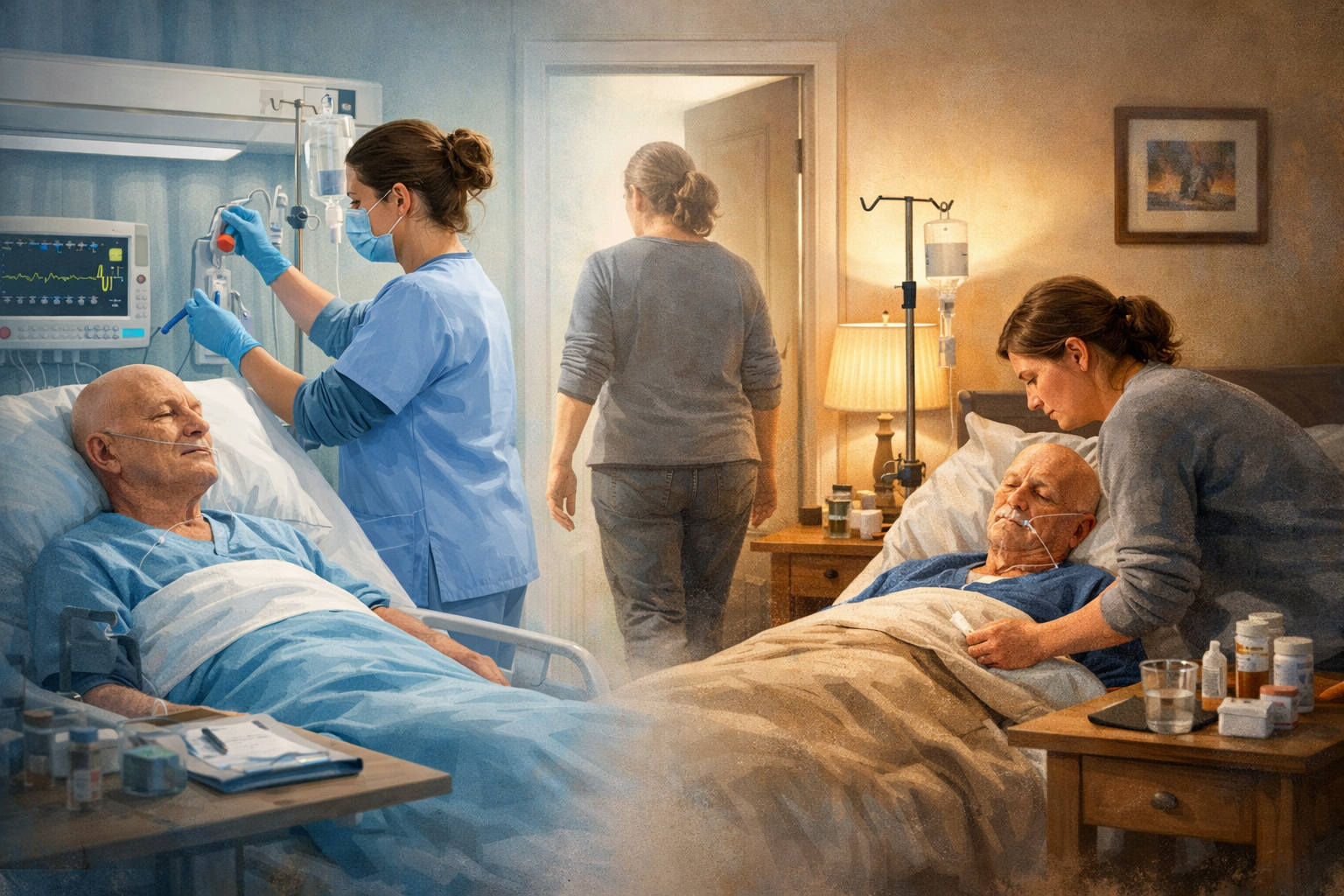
Objetivo: descrever a transição para o cuidador familiar nos espaços do hospital e domicílio. Método: estudo de caso qualitativo, na vertente pós-estruturalista dos estudos foucaultianos. Participaram cuidadores familiares vinculadas ao Programa de Internação Domiciliar Interdisciplinar de um hospital de ensino de Pelotas/RS, em 2019, mediante observação participante e a entrevista semiestruturada. Utilizou-se o programa Etnograph 6.0 com análise problematizadora. Resultados: participaram quatro cuidadoras de pessoa com câncer em cuidado paliativo. Emergiram duas categorias: Espaço hospitalar e, Espaço domiciliar. Na transição dos cuidadores familiares entre o hospital e o domicílio, a disciplina da instituição hospitalar se mantém no domicílio. Apesar do hospital flexibilizar a entrada para acompanhamento ou cuidado de um familiar internado e, a residência traz mais conforto ao paciente e responsabilidade para o cuidador. Conclusão: no hospital, o cuidador apreende técnicas disciplinares, as quais reproduzirá no domicílio conforme as relações de poder estabelecidas.
Referências
1. Cordeiro FRG, Oliveira FR, Giudice JZ, Fernandes VP, Oliveira AT. Definitions for “palliative care”, “end-of-life” and “terminally ill” in oncology: a scoping review. Enfermería [Internet]. 2020 [citado em 2 nov 2025]; 9(2):205-28. DOI: https://doi.org/10.22235/ech.v9i2.2317 DOI: https://doi.org/10.22235/ech.v9i2.2317
2. World Health Organization. Health topics. Palliative care [Internet]. Geneva, CH: WHO; 2020 [citado em 10 jan 2025]. Disponível em: https://www.who.int/news-room/fact-sheets/detail/palliative-care
3. World Health Organization. Câncer [Internet]. Geneva: WHO; c2025 [citado em 5 nov 2025]. Disponível em: https://www.who.int/health-topics/cancer#tab=tab_1
4. Ministério da Saúde (Brasil). Gabinete da Ministra. Portaria GM/MS nº 3.681, de 7 de maio de 2024. Institui a Política Nacional de Cuidados Paliativos - PNCP no âmbito do Sistema Único de Saúde (SUS) [Internet]. D. O. U., Brasília, DF: Ministério da Saúde; 22 maio 2024 [citado em 05 nov 2025]; Seção 1(1998): 215-8. Disponível em: https://www.in.gov.br/web/dou/-/portaria-gm/ms-n-3.681-de-7-de-maio-de-2024-*-565726225
5. Ministério da Saúde (Brasil). Secretaria de Atenção à Saúde. Departamento de Atenção Básica. Caderno de Atenção Domiciliar [Internet]. v. 2. Brasília, DF: Ministério da Saúde; 2013 [citado em 5 nov 2025]. Disponível em: https://drive.google.com/file/d/1XtDruy-YpzXKKG9jqhfyOEE84wdoMxZP/view
6. Mushtaq NS. Exploring the patients' and family members' perspectives on home-based palliative care. Int J Palliat Nurs. [Internet]. 2024 [citado em 10 jan 2025]; 30(10):548-55. DOI: https://doi.org/10.12968/ijpn.2024.30.10.548 DOI: https://doi.org/10.12968/ijpn.2024.30.10.548
7. Carers Australia. Annual Report 2021-22 [Internet]. Australia, CBR: Carers Australia Limited; 2021[citado em 10 jan 2025]. Disponível em: https://www.carersaustralia.com.au/wp-content/uploads/2022/11/FINAL-Carers-Australia-2021-22-Annual-Report.pdf
8. Silva AR, Petry S. As experiências de cuidadores informais de pacientes em tratamento oncológico paliativo: uma revisão integrativa. Ciênc Cuid Saúde [Internet]. 2021 [citado em 5 nov 2025]; (20):e55978. DOI: https://doi.org/10.4025/ciencuidsaude.v20i0.55978 DOI: https://doi.org/10.4025/ciencuidsaude.v20i0.55978
9. Dias LV, Oliveira SG, Bezerra BCC, Schiller GS, Fonseca EAF. Cuidadores familiares de pacientes sob cuidados paliativos no domicílio e hospital: revisão integrativa. Salud, Arte y Cuidado [Internet]. 2022 [citado em 5 nov 2025]; 15(2):63-74. DOI: https://doi.org/10.5281/zenodo.739499
10. Nascimento NG, Paes LV, Sousa IFR, Teixeira E, Ferreira DS, Lima FC, et al. Validação de tecnologia educacional para familiares/cuidadores de pacientes oncológicos elegíveis aos cuidados paliativos no domicílio. REME Rev Min Enferm. [Internet]. 2023 [citado em 5 nov 2025]; 27:e-1496. DOI: https://doi.org/10.35699/2316-9389.2023.40756 DOI: https://doi.org/10.35699/2316-9389.2023.40756
11. Paraíso MA. Metodologia de pesquisas pós-críticas em educação e currículo: trajetórias, pressupostos, procedimentos e estratégias analíticas. In: Meyer DE, Paraíso MA, organizadoras. Metodologias de pesquisas pós-críticas em educação. 3. ed. Belo Horizonte, MG: Mazza Edições; 2021. p. 17-24. (Coleção Pensar a Educação Pensar o Brasil).
12. Cardano M. Manual de pesquisa qualitativa: a contribuição da teoria da argumentação. Rio de Janeiro: Vozes; 2015.
13. Yin RK. Estudo de caso: planejamento e métodos. 5. ed. Porto Alegre, RS: Bookman; 2015.
14. Campos CJG, Saidel MGB. Amostragem em investigações qualitativas: conceitos e aplicações ao campo da saúde. Revista Pesquisa Qualitativa [Internet]. 2022 [citado em 5 nov 2025]; 10(25):404-24. DOI: http://dx.doi.org/10.33361/RPQ.2022.v.10.n.25.545 DOI: https://doi.org/10.33361/RPQ.2022.v.10.n.25.545
15. Bernard HR. Research methods in anthropology: qualitative and quantitative approaches. 6. ed. Lanham, MD: Rowman & Littlefield; 2017.
16. Conselho Nacional de Saúde (Brasil). Resolução Nº 466, de 12 de dezembro de 2012. Aprovar as seguintes diretrizes e normas regulamentadoras de pesquisas envolvendo seres humanos [Internet]. Brasília, DF: Ministério da Saúde; 2012 [citado em 05 nov 2025]. Disponível em: https://bvsms.saude.gov.br/bvs/saudelegis/cns/2013/res0466_12_12_2012.html
17. Foucault M. Microfísica do Poder. 18. ed. Rio de Janeiro: Paz e Terra; 2025. O nascimento do hospital. p. 171-89
18. Silva TWM, McLean D, Velloso IC. Disciplinary power on daily practices of nurses and physicians in the hospital. Nurs Inq. [Internet]. 2022 [citado em 5 nov 2025]; 29(2):e12455. DOI: https://doi.org/10.1111/nin.12455 DOI: https://doi.org/10.1111/nin.12455
19. Karlsen L, Mjølstad BP, Løfaldli BB, Helvik AS. Family caregiver involvement and role in hospital at home for adults: the patients’ and family caregivers’ perspective - a Norwegian qualitative study. BMC Health Serv Res. [Internet]. 2023 [citado em 5 nov 2025]; 23(1):499. DOI: https://doi.org/10.1186/s12913-023-09531-3 DOI: https://doi.org/10.1186/s12913-023-09531-3
20. Burgdorf JG, Arbaje AI, Chase J-A, Wolff JL. Current practices of family caregiver training during home health care: a qualitative study. J Am Geriatr Soc. [Internet]. 2022 [citado em 5 nov 2025]; 70(1):218-27. DOI: https://doi.org/10.1111/jgs.17492 DOI: https://doi.org/10.1111/jgs.17492
21. Bezerra BCC, Oliveira SG, Dias LV. El cuidador en el ambiente hospitalario: una revisión integrativa. Revista Urug Enferm. [Internet]. 2020 [citado em 5 nov 2025]; 15(1):1-17. DOI: https://doi.org/10.33517/rue2020v15n1a3 DOI: https://doi.org/10.33517/rue2020v15n1a3
22. Santos Júnior EB, Freitas MC, Guedes MVC, Pereira MLD, Nogueira JM, Mota FRN. Representações sociais do idoso cuidador de idoso em ambiente hospitalar. Contrib Cienc Soc. [Internet]. 2023 [citado em 5 nov 2025]; 16(7):5419-35. DOI: https://doi.org/10.55905/revconv.16n.7-014 DOI: https://doi.org/10.55905/revconv.16n.7-014
23. Azeredo YN, Schraiber LB. Autoridade, poder e violência: um estudo sobre humanização em saúde. Interface Comum Saúde Educ. [Internet]. 2021 [citado em 5 nov 2025]; 25:e190838. DOI: https://doi.org/10.1590/Interface.190838 DOI: https://doi.org/10.1590/interface.190838
24. Robertson SB, Hjörleifsdóttir E, Sigurðardóttir Þ. Family caregivers’ experiences of end-of-life care in the acute hospital setting. A qualitative study. Scand J Caring Sci. [Internet]. 2022 [citado em 5 nov 2025]; 36(3):686-98. DOI: https://doi.org/10.1111/scs.13025 DOI: https://doi.org/10.1111/scs.13025
25. Moura A, Amorim M, Pais SC, Alves E. Becoming experts: life changes, adaptation, and learning of stroke survivors’ informal caregivers. Heal Soc Care Community [Internet]. 2025 [citado em 5 nov 2025]; 2025(1):418706. DOI: https://doi.org/10.1155/hsc/2418706 DOI: https://doi.org/10.1155/hsc/2418706
26. Perboni JS, Oliveira SG, Tristão FS. “Ô de casa!”: uma análise foucaultiana da atenção domiciliar. Rev Contexto & Saúde [Internet]. 2022 [citado em 5 nov 2025]; 22(45):e10853. DOI: https://doi.org/10.21527/2176-7114.2022.45.10853 DOI: https://doi.org/10.21527/2176-7114.2022.45.10853
27. Silva YC, Silva KL, Velloso ISC. Práticas utilizadas pela equipe do Serviço de Atenção Domiciliar: implicações sobre os cuidadores. Rev Bras Enferm. [Internet]. 2021 [citado em 5 nov 2025]; 74(2):e20190794. DOI: https://doi.org/10.1590/0034-7167-2019-0794 DOI: https://doi.org/10.1590/0034-7167-2019-0794
28. Isenberg SR, Killackey T, Saunders S, Scott M, Ernecoff NC, Bush SH, et al. "Going home [is] just a feel-good idea with no structure": a qualitative exploration of patient and family caregiver needs when transitioning from hospital to home in palliative care. J Pain Symptom Manage [Internet]. 2021 [citado em 5 nov 2025]; 62(3):e9-e19. DOI: https://doi.org/10.1016/j.jpainsymman.2021.02.026 DOI: https://doi.org/10.1016/j.jpainsymman.2021.02.026
29. Foucault M. Microfísica do Poder. 18. ed. Rio de Janeiro: Paz e Terra; 2025. Sobre a história da sexualidade. p. 363-406
30. Bertagnoli MSFF, Melchior MI, Monti RG, Kimura RA. Desafios para a gestão compartilhada do cuidado na relação entre cuidadores e profissionais de uma equipe do Serviço de Atenção Domiciliar. Physis [Internet]. 2021 [citado em 5 nov 2025]; 31(1):e310113. DOI: https://doi.org/10.1590/S0103-73312021310113 DOI: https://doi.org/10.1590/s0103-73312021310113
Downloads
Publicado
Edição
Seção
Licença
Copyright (c) 2025 Revista Família, Ciclos de Vida e Saúde no Contexto Social

Este trabalho está licenciado sob uma licença Creative Commons Attribution-NonCommercial 4.0 International License.
Este trabalho está licenciado sob uma licença Creative Commons Attribution-NonCommercial 4.0 International License.


 Revistas UFTM