Frailty syndrome in institutionalized older adults in Brazil
prevalence, components, associated factors, and implications for long-term care
DOI:
https://doi.org/10.18554/refacs.9370Keywords:
Frail Elderly, Frailty, Homes for the Aged, Prevalence, Long-Term Care, Geriatric assessmentAbstract
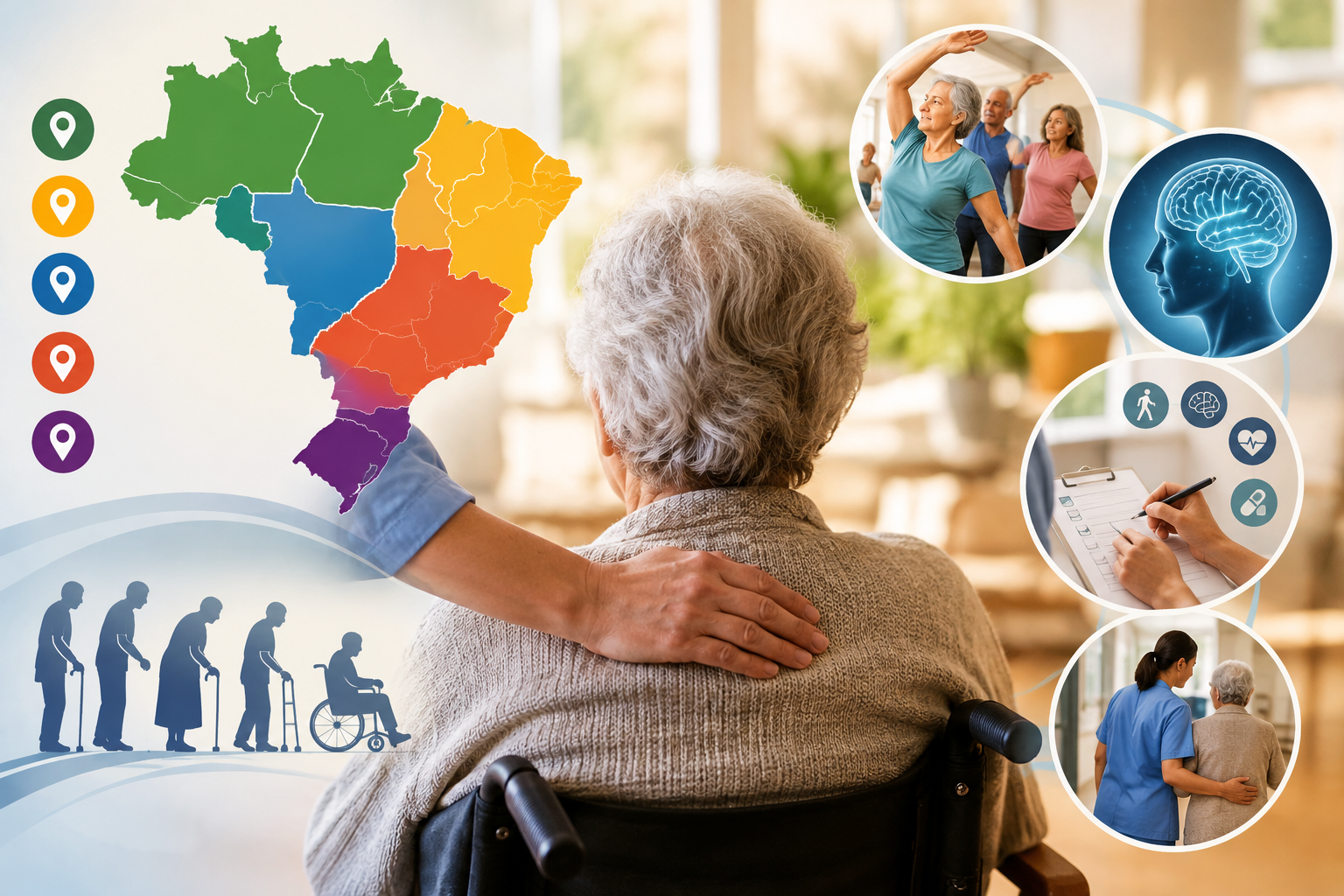
Objective: to analyze the prevalence, components, associated factors, and outcomes of frailty syndrome among older adults in long-term care institutions across the five Brazilian regions. Methods: a cross-sectional, descriptive, and analytical study involving 4,166 residents. Data collection took place between 2015 and 2018. Frailty was measured using a self-reported instrument, validated in Brazil, based on the Fried phenotype: unintentional weight loss, fatigue, reduced strength, slow walking speed, and low physical activity. The original classification categorized individuals as non-frail (0 components), pre-frail (1–2 components), and frail (≥3 components). For the logistic regression models, pre-frail and frail individuals were grouped into a single category: "with frailty" (≥1 component). Regional logistic regression models were adjusted. Results: the proportion of individuals with at least one frailty component ranged from 81.3% to 85.7%. According to the original phenotypic classification, frailty (≥3 components) ranged from 43.5% in the North region to 52.2% in the Southeast region, while pre-frailty ranged from 30.4% to 42.1%. The most frequent component was slow walking speed (65.5%–72.2%), followed by low physical activity (47.7%–58.8%). Functional dependence was associated with the "with frailty" category in all regions, with odds ratios (OR) ranging from 3.61 to 12.57. Multimorbidity and depressive symptoms showed associations in the Northeast and Central-West regions; age ≥80 years was associated in the South region; longer duration of institutionalization in the Central-West region; and hospitalization in the Central-West and Southeast regions. Conclusion: frailty was highly prevalent, with regional heterogeneity in the associated factors. Its consistent association with functional dependence underscores the need for periodic screening, multidimensional assessment, and multicomponent interventions. Structured exercise programs can improve frailty, physical function, and cognition – even among nursing home residents – supporting the integration of preventive and rehabilitative strategies into institutional care.
References
1. Kim DH, Rockwood K. Frailty in older adults. N Engl J Med. [Internet]. 2024 [citado em 8 set. 2026]; 391(6):538-48. DOI: https://www.nejm.org/doi/10.1056/NEJMra2301292
2. Fried LP, Tangen CM, Walston J, Newman AB, Hirsch C, Gottdiener J, et al. Frailty in older adults: evidence for a phenotype. J Gerontol A Biol Sci Med Sci. 2001; 56(3):M146-56.
3. Kojima G. Prevalence of frailty in nursing homes: a systematic review and meta-analysis. J Am Med Dir Assoc [Internet]. 2015 [citado em 8 set. 2026]; 16(11):940-5. DOI: https://doi.org/10.1016/j.jamda.2015.06.025
4. Liu J, Zhu Y, Tan JK, Ismail AH, Ibrahim R, Hassan NH. Factors associated with frailty in older adults in community and nursing home settings: a systematic review with a meta-analysis. J Clin Med [Internet]. 2024 [citado em 8 set. 2026]; 13(8):2382. DOI: https://doi.org/10.3390/jcm13082382
5. Bian J, Chen Z, Gao Y, Lau FY, Fong DYT, Choi EPH, et al. Prevalence of cognitive frailty, reversible and potentially reversible cognitive frailty among older adults without dementia: a systematic review and meta-analysis. J Gerontol B Psychol Sci Soc Sci [Internet]. 2026 [citado em 8 set. 2026]; 81(1):gbaf228. DOI: https://doi.org/10.1093/geronb/gbaf228
6. Cheng M, Liu Q, Li M, He M. Cognitive frailty as a predictor of hospitalisation among older adults: a systematic review and meta-analysis. Psychogeriatrics [Internet]. 2025 [citado em 8 set. 2026]; 25(1):e13213. DOI: https://doi.org/10.1111/psyg.13213
7. Shivgulam ME, Liu H, Zafar Z, Cheema M, Ahmadi S, Theou O, et al. Exercise interventions improve frailty in patients living in long-term care: a systematic review and meta-analysis. J Am Med Dir Assoc [Internet]. 2025 [citado em 8 set. 2026]; 26(12):105945. DOI: https://doi.org/10.1016/j.jamda.2025.105945
8. Pradana AA, Hidayat AT, Yanti L, Lee SC. Effect of physical exercise on frailty in older nursing home residents: a systematic review and meta-analysis. J Am Geriatr Soc. [Internet]. 2026 [citado em 8 set. 2026]; 74(5):1450-63. DOI: https://doi.org/10.1111/jgs.70330
9. Zhu Y, Zhang Y, Li X, Du Z. Effects of exercise interventions on physical function, cognitive function and quality of life of frail older adults in nursing homes: a systematic review and meta-analysis. Front Psychol [Internet]. 2025 [citado em 8 set. 2026]; 16:1679734. DOI: https://doi.org/10.3389/fpsyg.2025.1679734
10. Duarte YAO, Watanabe HAW, Giacomin KC, Lebrão ML. Estudo das condições sociodemográficas e epidemiológicas dos idosos residentes em instituições de longa permanência para idosos registradas no Censo SUAS: relatório final revisado. São Paulo; 2025.
11. Ferreira SP, Palma RS, Ribeiro KS, Miranda VCR, Teodoro ECM, Pereira ECA. Prevalência da síndrome da fragilidade e perfil clínico e sociodemográfico dos idosos institucionalizados de Pindamonhangaba/SP. Fisioter Bras. [Internet]. 2021 [citado em 8 set. 2026]; 22(6):809-23. DOI: https://doi.org/10.33233/fb.v22i6.4123
12. Oliveira JM, Duarte YAO, Watanabe HAW. Condições de saúde e demandas assistenciais de residentes de instituições de longa permanência: panorama regional. Rev Fam Ciclos Vida Saúde Contexto Soc. [Internet]. 2024 [citado em 8 set. 2026]; 12(3):e7844. DOI: https://doi.org/10.18554/refacs.v12i3.7844
13. Nunes DP, Duarte YAO, Santos JLF, Lebrão ML. Rastreamento de fragilidade em idosos por instrumento autorreferido. Rev Saúde Pública [Internet]. 2015 [citado em 8 set. 2026];49:2. DOI: https://doi.org/10.1590/S0034-8910.2015049005516
14. Ribeiro EG, Mendoza IYQ, Cintra MTG, Bicalho MAC, Guimarães GL, Moraes EM. Fragilidade no idoso: possibilidades de rastreio na Atenção Primária à Saúde. Rev Bras Enferm [Internet]. 2022 [citado em 8 set. 2026]; 75(2):e20200973. DOI: https://doi.org/10.1590/0034-7167-2020-0973
15. Pan Y, Ma L. Inflammatory markers and physical frailty: towards clinical application. Immun Ageing [Internet]. 2024 [citado em 8 set. 2026]; 21:2. DOI: https://doi.org/10.1186/s12979-023-00410-3
16. World Health Organization. Long-term care for older people: package for universal health coverage. Geneva: WHO; 2024 [citado em 8 set. 2026]. Disponível em: https://iris.who.int/items/538ef171-82cf-427d-8e1a-0c26a1b032ba
17. Yuan Y, Lapane KL, Tjia J, Baek J, Liu SH, Ulbricht CM. Physical frailty and cognitive impairment in older nursing home residents: a latent class analysis. BMC Geriatr. [Internet]. 2021 [citado em 8 set. 2026]; 21:487. DOI: https://doi.org/10.1186/s12877-021-02433-1
18. Moreno-Martin P, Jerez-Roig J, Rierola-Fochs S, Oliveira VR, Farrés-Godayol P, Souza DLB, et al. Incidence and predictive factors of functional decline in older people living in nursing homes: a systematic review. J Am Med Dir Assoc [Internet]. 2022 [citado em 8 set. 2026]; 23(11):1815-25.e9. DOI: http://dx.doi.org/10.1016/j.jamda.2022.05.001
19. Presidência da República (BR). Lei nº 15.069, de 23 de dezembro de 2024. Institui a Política Nacional de Cuidados [Internet]. Brasília, DF: Presidência da República; 2024 [citado em 8 set. 2026]. Disponível em: https://www.planalto.gov.br/ccivil_03/_ato2023-2026/2024/lei/l15069.htm
20. Presidência da República (BR). Decreto nº 12.562, de 23 de julho de 2025. Regulamenta os arts. 9º e 11 da Lei nº 15.069/2024 e institui o Plano Nacional de Cuidados [Internet]. Brasília, DF: Presidência da República; 2025 [citado em 8 set. 2026]. Disponível em: https://www.planalto.gov.br/ccivil_03/_ato2023-2026/2025/decreto/d12562.htm
Downloads
Published
Issue
Section
License
Copyright (c) 2026 Revista Família, Ciclos de Vida e Saúde no Contexto Social

This work is licensed under a Creative Commons Attribution-NonCommercial 4.0 International License.
Each of the authors of the manuscript must complete and sign a copy of Statement of Responsibility and Copyright Transfer Agreement, which must be attached, by the submitting author, in step 4 of the submission process in the journal system (Click on the "Browse" option, select the file that should be inserted in pdf format, click on the "Download" button, in the "Title" field type: Declaration of responsibilities, then click the "Save and Continue" button and proceed with the submission process.
Note: Including scanned signature will not be accepted. Each author of the manuscript must complete a declaration individually.

REFACS de Universidade Federal do Triângulo Mineiro está licenciado com uma Licença Creative Commons - Atribuição-NãoComercial 4.0 Internacional.
Baseado no trabalho disponível em www.uftm.edu.br.
Podem estar disponíveis autorizações adicionais às concedidas no âmbito desta licença em http://www.uftm.edu.br/refacs.


 Revistas UFTM