Psychoeducational program to improve the quality of family life for adolescents and adults with intellectual disabilities and/or autism
DOI:
https://doi.org/10.18554/refacs.v14i00.8700Keywords:
Adolescent, Intellectual disability, Autism Spectrum Disorder, Family, Quality of LifeAbstract
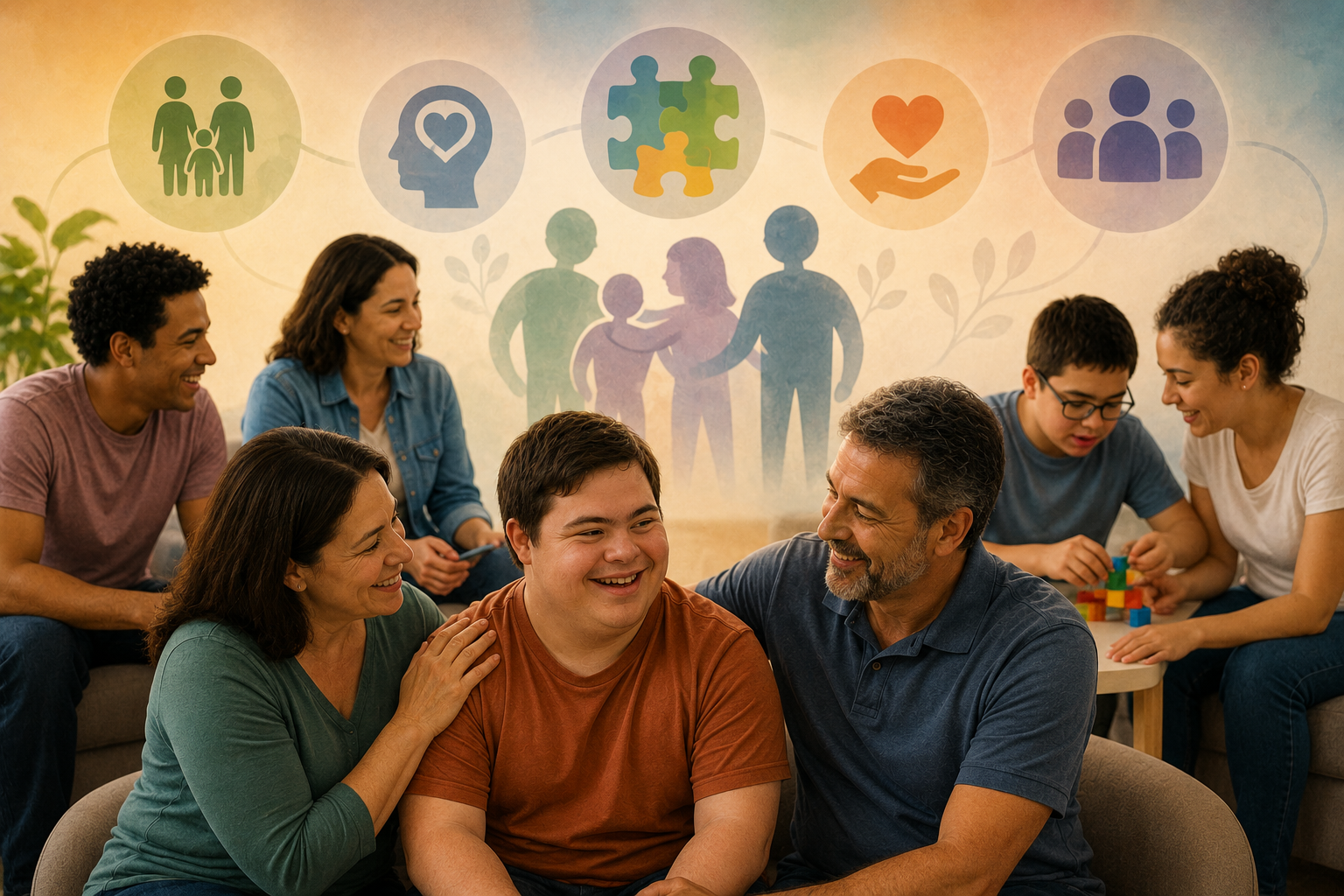
Objective: to evaluate the effects of a psychoeducational program on family quality of life for family members of adolescents and adults with intellectual disabilities and/or autism spectrum disorder. Methods: a quantitative. descriptive, quasi-experimental study was conducted with family members participating in a psychoeducational program in the first semester of 2023. Data collection was carried out using the Family Quality of Life Scale for families with children with Intellectual and/or Developmental Disabilities and descriptive reports, before and after the intervention. Data were analyzed using descriptive statistics of field diary entries made throughout the intervention. Results: six family members participated, most of whom had complete secondary school education (four mothers, one aunt, and one grandmother) who cared for individuals aged 10 to 21 years. Sixteen weekly one-and-a-half-hour meetings were offered. Slight variations were observed in family quality of life scores between pre and post-intervention periods, with maintenance or worsening in some domains. Conversely, field diary data indicated an increased perception of support, strengthened family bonds, and greater awareness of educational practices and care strategies. Conclusion: the program proved to be a viable strategy for promoting reflection and strengthening family relationships, indicating the relevance of family-centered interventions in the context of adolescence and adulthood for people with intellectual disabilities and/or autism.
References
1. Papadopoulos A, Tsapara A, Gryparis A, Tafiadis D, Trimmis N, Plotas P, et al. A prospective study of the family quality of life, illness perceptions, and coping in mothers of children newly diagnosed with autism spectrum disorder and communication difficulties. Eur J Investig Health Psychol Educ. 2024 [citado em 10 abr 2026]; 14(8):2187-2204. DOI: https://doi.org/10.3390/ejihpe14080146
2. Benitez P, Domeniconi C. Inclusão escolar: o papel dos agentes educacionais brasileiros. Psicol Cienc Prof. 2015 [citado em 10 abr 2026]; 35(4):1007-23. DOI: https://doi.org/10.1590/1982-3703000652014
3. McWilliam R. Metanoia en atención temprana: transformación a un enfoque centrado en la familia. Rev. Latinoam Educ Inclusiva 2016 [citado em 10 abr 2026]; 10(1):133-53. DOI: https://doi.org/10.4067/S0718-73782016000100008
4. McWilliam RA, editor. Working with families of young children with special needs. New York: Guilford Press; 2010.
5. McStay RL, Trembath D, Dissanayake C. Stress and family quality of life in parents of children with autism spectrum disorder: parent gender and the double ABCX model. J Autism Dev Disord. 2014 [citado em 10 abr 2026]; 44:3101-18. DOI: https://doi.org/10.1007/s10803-014-2178-7
6. Andrade AA, Ohno PM, Magalhães CG, Barreto IS. Treinamento de pais e autismo: uma revisão de literatura. Cien Cogn. 2016; 21(1):7-22.
7. Nuske HJ, Hassrick EM, Bronstein B, Hauptman L, Aponte C, Levato L, et al. Broken bridges: new school transitions for students with autism spectrum disorder: a systematic review on difficulties and strategies for success. Autism. 2018 [citado em 10 abr 2026]; 23(2):306-25. DOI: https://doi.org/10.1177/1362361318754529
8. Benitez P, Albuquerque I, Manoni NV, Ribeiro AF, Bondioli RM. Centro de aprendizagem e desenvolvimento: estudo de caso interdisciplinar em ABA. Psicologia: Teoria e Prática. 2020 [citado em 10 abr 2026]; 22(1):351-67. DOI: https://doi.org/10.5935/1980-6906/psicologia.v22n1p351-367
9. Weber LND. Eduque com carinho: equilíbrio entre amor e limites. 4. ed. Curitiba: Juruá, 2012.
10. Dunst CJ, Raab M, Trivette C, Swanson J. Community-based everyday child learning opportunities. In: McWilliam RA, editor. Working with families of young children with special needs. New York: Guilford Press; 2010. p. 60-92.
11. Giné C, Mas JM, Balcells-Balcells A, Baqués N, Simón C. Escala de calidad de vida familiar para familias con hijos/as menores de 18 años con discapacidad intelectual y/o en el desarrollo: versión revisada 2019. Madrid: Plena Inclusión; 2019.
12. Jorge BM, Levy CCAC, Granato L. Adaptação cultural da Escala de Qualidade de Vida Familiar (Family Quality of Life Scale) para o português brasileiro. CoDAS. 2015 [citado em 10 abr 2026]; 27(6):534-40. DOI: https://doi.org/10.1590/2317-1782/20152014142
13. Nunes AC, Luiz EAM, Barba PCSD. Qualidade de vida familiar: uma revisão integrativa sobre família de pessoas com deficiência. Cien Saude Colet. 2021 [citado em 10 abr 2026]; 26(7):2873-88. DOI: https://doi.org/10.1590/1413-81232021267.06962019
14. Balcells-Ballcells A, Giné C, Guàrdia-Olmos J, Summers JA, Mas JM. Impact of supports and partnership on family quality of life. Res Dev Disabil. 2019 [citado em 10 abr 2026]; 85:50-60. DOI: https://doi.org/10.1016/j.ridd.2018.10.006
15. American Psychiatric Association. Manual diagnóstico e estatístico de transtornos mentais: DSM-5. 5ed. Porto Alegre: Artmed; 2014.
16. Gentille M, Messineo L, La Guardia D, Arrigo M, Città G, Ayala A, et al. A parent-mediated telehealth program for children with autism spectrum disorder: promoting parents’ ability to stimulate the children’s learning, reduce parenting stress, and boost their sense of parenting empowerment. J Autism Dev Disord. 2022 [citado em 10 abr 2026]; 52(12):5285-300. DOI: https://doi.org/10.1007/s10803-022-05482-6
17. Cruz ACB, Minetto MF, Weber LND. Adaptação do “programa de qualidade na interação familiar” para famílias com filhos com transtorno do espectro autista. Revista INFAD de Psicología. 2019 [citado em 10 abr 2026]; 2(1):399-410. Disponível em: https://revista.infad.eu/index.php/IJODAEP/article/view/1473
18. Papanikolaou K, Ntre V, Gertsou IM, Tagkouli E, Tzavara C, Pehlivanidis A, et al. Parenting children with autism spectrum disorder during crises: differential responses between the financial and the COVID-19 pandemic crisis. J Clin Med. 2022 [citado em 10 abr 2026]; 11(5):1264. DOI: https://doi.org/10.3390/jcm11051264
19. Pancia C, Gunning C, McTiernan A, Holloway J. Developing the Parent-coaching Assessment, Individualization, and Response to Stressors (PAIRS) tool for behavior analysts. J Autism Dev Disord. 2023 [citado em 10 abr 2026]; 53(9):3319-42. DOI: https://doi.org/10.1007/s10803-022-05637-5
20. Domeniconi C, Gràcia M. Efectos de una intervención siguiendo el modelo enfocado en la familia para promover avances en el desarrollo del lenguaje de los niños. Rev Investig Logop. 2018; 8(2):165-81.
21. Frugone-Jaramillo M, Gràcia M. Family-centered approach in early childhood intervention of a vulnerable population from an Ecuadorian rural context. Front Psychol. 2023 [citado em 10 abr 2026]; 14:1272293. DOI: https://doi.org/10.3389/fpsyg.2023.1272293
22. Gràcia M. Intervención naturalista en la comunicación y el lenguaje en ámbito familiar: un estudio de cuatro casos. Infanc Aprendiz. 2001 [citado em 10 abr 2026]; 24(3):307-24. DOI: https://doi.org/10.1174/021037001316949248
23. Gràcia M. Comunicación y lenguaje en primeras edades: intervención con familias. Barcelona: Editorial Milenio, 2002.
24. Associação Brasileira de Empresas de Pesquisa (ABEP). Critério de classificação socioeconomica, 2022. Disponível em: https://abep.org/wp-content/uploads/2024/09/01_cceb_2022.pdf
25. Weber LND, Salvador AP, Brandenburg O. Programa de qualidade na interação familiar: manual para facilitadores. 3ed. Curitiba: Juruá, 2018.
26. Cruz ACB, Minetto MFJ, Weber LND, Alencar MSO, Oliveira CRS. Programa de qualidade na interação familiar e TEA: validade social. Psicologia Argumento. 2022 [citado em 10 abr 2026]; 40(109):1797-815. DOI: https://doi.org/10.7213/psicolargum40.109.AO07
27. Gerhardt TE, Silveira DF, organizadores. Métodos de pesquisa. Porto Alegre: Editora da UFRGS, 2009.
Downloads
Published
Issue
Section
License
Copyright (c) 2026 Revista Família, Ciclos de Vida e Saúde no Contexto Social

This work is licensed under a Creative Commons Attribution-NonCommercial 4.0 International License.
Each of the authors of the manuscript must complete and sign a copy of Statement of Responsibility and Copyright Transfer Agreement, which must be attached, by the submitting author, in step 4 of the submission process in the journal system (Click on the "Browse" option, select the file that should be inserted in pdf format, click on the "Download" button, in the "Title" field type: Declaration of responsibilities, then click the "Save and Continue" button and proceed with the submission process.
Note: Including scanned signature will not be accepted. Each author of the manuscript must complete a declaration individually.

REFACS de Universidade Federal do Triângulo Mineiro está licenciado com uma Licença Creative Commons - Atribuição-NãoComercial 4.0 Internacional.
Baseado no trabalho disponível em www.uftm.edu.br.
Podem estar disponíveis autorizações adicionais às concedidas no âmbito desta licença em http://www.uftm.edu.br/refacs.


 Revistas UFTM